
Your largest customer is 40% of revenue.
You already know that is concentrated. Everyone tells you so, usually in a tone that suggests you had a choice about it. Most businesses this size did not. One customer said yes early, kept saying yes, and grew faster than the rest of the book.
So the useful question is not whether 40% is too much. It is this one:
What happens to your cash if that customer behaves slightly differently?
Not if they leave. Slightly differently.
They do not have to go anywhere to hurt you
Picture five things, none of which involves losing the account.
- They reduce orders by 15% after a reorganisation.
- They move you from 45-day to 75-day terms because their own treasury team said so.
- They renegotiate price at renewal and win two points.
- They pause one product line for a quarter.
- They dispute a £180K invoice and hold it while procurement investigates.
Every one of those is a Tuesday in the life of a large customer. None of them is a crisis. Your P&L might barely flinch.
Your bank account is a different story, because four of those five are cash events before they are profit events.
Run three scenarios, not twenty
You do not need a model with forty switches. You need three versions of your existing cash forecast.
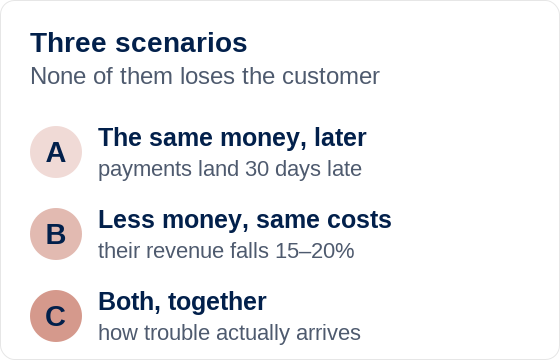
Scenario A: the same money, later
Keep revenue exactly as it is. Move every payment from that customer 30 days later.
Now look at payroll, VAT, PAYE, your quarterly rent and your largest supplier payment. Do they all still clear, in the week they fall due, without the overdraft?
This is the scenario founders underestimate most, because nothing has gone wrong in it. The customer is still happy. The work is still good. The money is just late.
Scenario B: less money, same costs
Reduce that customer's revenue by 15% to 20%.
Then be honest about which of your costs actually leave with it. Raw materials and subcontractors, mostly yes. Rent, salaries, software, insurance and the finance system you implemented last year, no.
Revenue can fall in a month. A cost base takes two quarters to move, and some of it never does. The gap between those two speeds is the whole risk.
Scenario C: both, together
Fewer orders and slower payment, in the same quarter.
Run it even though it feels pessimistic, because this is how trouble actually arrives. A customer under pressure does not usually cut orders or stretch terms. They do both, for the same underlying reason, in the same month.
Set the trigger points before anything happens
A scenario that does not change a decision is just a spreadsheet you built on a Thursday.
So the output of this exercise is not three charts. It is three sentences, written down and agreed while everyone is calm:
- "If forecast cash in any week falls below £X, we freeze recruitment until it recovers."
- "If their debtor days pass Y, I call their finance director myself. Not the credit controller."
- "If concentration goes above Z%, new business in other accounts gets priority over further expansion in this one."
The numbers in those sentences will be different in your business. The principle is the same everywhere: decide the response now, when nothing is at stake, because the version of you who decides in the middle of a cash squeeze will decide worse.
If your runway assumes your largest customer behaves perfectly, you do not know your runway. You know your best case.
Why this is a cash exercise, not a sales one
The instinct when someone raises concentration is to talk about diversification. Win more customers, spread the risk, reduce the number.
That is correct and it is slow. Winning enough new business to move a 40% share meaningfully takes a year or more, and it does nothing for you this quarter.
What you can change this quarter is how much warning you get. The concentration stays. The surprise does not have to. That distinction is the one that separates a business with a big customer from a business at the mercy of one, and it is the same mechanism behind why profitable businesses still run out of cash.
One more thing worth checking while you are in there: the arithmetic of what that customer is holding. Annual sales to them, multiplied by the days they actually pay, divided by 365. On £4M at 60 days, that is £657K of your money sitting on their balance sheet at any moment. At 75 days it is £822K. The £165K difference is the cost of a terms change nobody negotiated.
Key takeaway: A large customer does not need to leave to cause a cash problem. Model slower payment, lower demand and both together, then write down the trigger points while nothing is going wrong.
Where to start this week
Open your cash forecast and your aged debtor report side by side.
Find your largest customer. Push every expected receipt from them back by 30 days, and read the bottom row again. That is Scenario A, and it takes about ten minutes.
If the answer makes you uncomfortable, you have learned something that no amount of revenue growth will fix on its own. If it does not, you have just bought yourself a genuinely reassuring fact.
Either way you will know, which is the entire point.
What does your cash look like if your biggest customer pays you a month later than usual?