
"We'll make it up on volume" is the most expensive sentence in a founder-led business.
Say you run on a 40% gross margin. A 10% discount needs 33% more volume just to leave you where you started.
Not 10% more. A third more.
A 10% discount needs a third more volume
Sell something at £100. It costs you £60 to deliver, so you keep £40.
Knock 10% off the price and you now sell it at £90. The £60 doesn't move. You keep £30.
To make the same £40-per-sale profit pool you had before, you need £40 ÷ £30 = 1.33 times the volume. A third more of everything, to end up exactly where you were.
The general version is one line:
Volume needed to stand still = discount ÷ (gross margin - discount)
On a 40% margin, that plays out like this:
- 5% discount: 14% more volume
- 10% discount: 33% more volume
- 15% discount: 60% more volume
- 20% discount: double the volume
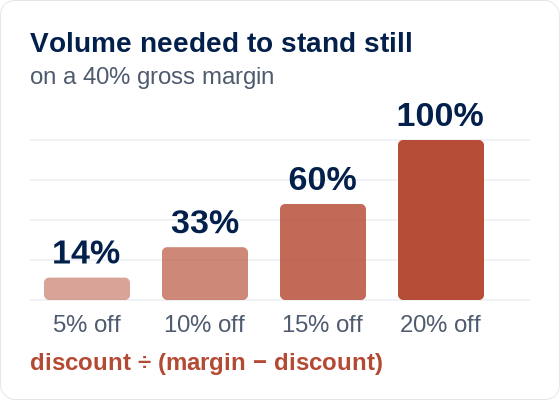
And the thinner your margin, the worse it gets. On a 30% margin, the same 10% discount needs 50% more volume. On a 60% margin it needs 20%.
Price is the only number in your business with nothing standing in front of it.
Every other lever has a cost attached. More volume brings more cost of goods, more people, more working capital. A price change drops straight to gross profit, in both directions.
The same sum runs the other way
On that same 40% margin, put your price up 10% and you keep £50 a sale instead of £40.
You could lose a fifth of your customers and be no worse off. The formula is the mirror image: price rise ÷ (gross margin + price rise). Here that's 10% ÷ 50%, so 20%.
I'm not telling you to raise your prices. That depends on your market, your customers and what you sell.
But if losing 20% of your volume frightens you more than giving away a third of your gross profit, that's worth sitting with for a while.
Why the reflex is so hard to give up
I understand why the discount is the first thing founders reach for.
It's the one lever you can pull on your own, this afternoon, with nobody's permission. You offer it, the deal closes, and you watch it work the same week.
Terms, product mix, process, what you actually sell: those take months, and none of them has a moment where you see it land.
The discount also gets measured in the place everyone looks. I've sat in a lot of commercial reviews, and I can't remember a sales target ever being set on gross profit. Revenue is the scoreboard, so a discount that grows revenue looks like a win in the meeting even when it shrinks what the business keeps.
Underneath all of it sits an assumption nobody says out loud: that price and volume trade one for one.
They don't. The arithmetic above is how far apart they are.
Three questions nobody asks after the discount
Think about the last discount you signed off. Then ask:
- Who worked out the volume it needed? If nobody did, the decision was made on hope.
- Who checked, a year on, whether that volume turned up? A discount has a start date and almost never a review date.
- And when it didn't turn up, what got blamed? Usually the market, the sales team or the season. Rarely the price.
None of those questions is hard. They just don't get asked, because by the time the answer is knowable the discount has become the normal price.
When a discount is the right call
None of this makes discounting wrong.
To get into a new market, to clear stock that's costing you money to hold, to win a customer you've wanted for years: all sound reasons.
The difference between a good discount and an expensive one is whether you can say, before you sign it off, what volume it needs and when you'll check. Write both down. If the number looks unreachable when you write it, that's the most useful thing you'll learn all week.
One more thing to watch. Extra volume isn't free on the cash side either. More sales usually means more stock and more money owed to you, often by the bigger customers who negotiated the discount in the first place. A business can win the volume back and still feel poorer, which is a pattern I've written about in why profitable businesses run out of cash.
The argument that stopped being an argument
Years ago I worked through a supply chain shock in a pharma business.
The room had been arguing for weeks. Half wanted to protect margin whatever it cost in volume. The other half wanted to protect volume and worry about margin later.
There were three options on the table:
- Absorb the cost and lose 12 points of margin
- Pass it on and lose 8% of the volume
- Redesign the supply chain, with an 18-month payback that was nobody's favourite
We modelled all three instead of debating them. The redesign won, and eighteen months on margins were 6% better than before any of it started.
The argument was never resolved. It was quantified, and then it stopped being an argument.
No system, no consultant. One line of arithmetic, run before the decision instead of after it.
Key takeaway: A discount is a promise to sell more, and on a 40% margin it's a big one. Before you sign it off, work out the volume it needs to stand still, write down when you'll check, and check.
Where to start this week
Find the last discount you approved and your gross margin on that product or customer.
Divide the discount by (margin minus discount). That's the volume increase it needed just to leave you where you started. Then pull the sales numbers and see whether it arrived.
It takes ten minutes, and nobody in the business has to know you did it.
What volume increase did your last discount need, and did it turn up?