
Sales presents a £5M forecast. Finance presents £3.5M.
The meeting runs twenty minutes long, everyone gets tired of it, and somebody suggests calling it £4.25M.
That is the worst number available. Nobody owns it, no assumption underneath it has a name, and when it turns out to be wrong in March there will be nothing to learn from it. You cannot debug an average.
The £1.5M gap is not the problem. Not being able to explain the £1.5M is the problem.
One word, four meanings
In most businesses past £10M, four functions use the word "pipeline" and mean four different things.
Sales means the full value of the opportunities it is working on. That is the right number for a sales conversation, because it is what the team is trying to win.
Finance means those values discounted by the chance of winning them. Also right, for a different purpose.
Operations means the dates on which the work can actually be delivered. A deal signed in December that the team cannot start until March is a March problem.
Cash means the day the money arrives. December revenue on 60-day terms is February cash, and February cash does not pay a January payroll.
Four reasonable views of the same set of customers, producing four different numbers. Everyone is right, which is exactly why the argument never resolves.
Four perfectly reasonable views of the same customer can produce four completely different numbers.
Five questions for every material opportunity
The fix is not a more sophisticated spreadsheet. It is making every material opportunity answer the same five questions before it goes into anyone's forecast.
1. What is the value, and is it contracted?
Separate signed revenue from expected revenue. These are different kinds of number and they should never sit in the same column without a label.
2. What is the probability, and who set it?
A verbal "this looks good" from a prospect is not 90%. If the salesperson owning the deal cannot say what moved it from 50% to 80%, it has not moved.
3. When can we actually fulfil it?
Closing a deal in December does not make it December revenue. Ask what has to be built, hired, shipped or installed first, and when that can realistically start.
4. When do we invoice?
Milestones matter more than most forecasts admit. A £600K contract invoiced in three stages is three different cash events, and the last one may be two quarters away.
5. When does the cash land?
Take the invoice date and add the terms the customer actually pays to, not the terms printed on the invoice. If your largest customers run 15 days past, that is your real number.
Three views, not one
Once every opportunity has those five answers, you can produce three numbers instead of arguing about one.
Committed revenue. Signed, contracted, and deliverable. This is the floor, and almost nothing about it should be in dispute.
Weighted revenue. Committed plus probability-adjusted pipeline. This is the number a budget gets built on, and it is the one most businesses mean when they say "the forecast".
Expected cash. The weighted number pushed through fulfilment, invoicing and payment timing. This is the number that decides whether you can hire in February.
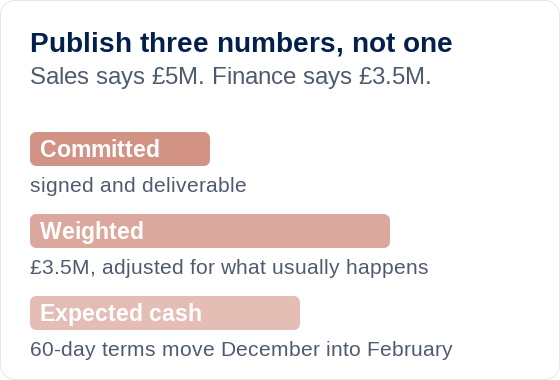
Here is why the third one matters. Take £5M of opportunity at a 70% weighting: £3.5M of weighted revenue. Now assume two thirds of it closes in the last six weeks of the year, invoices on completion, and sits on 60-day terms. A meaningful share of that £3.5M is not cash until the following March.
The P&L forecast and the cash forecast are now telling you two true things that point in opposite directions. That is not a contradiction to resolve. It is the actual shape of your year, and you want to see it in November rather than discover it in February. A rolling 13-week cash view is where that discovery happens early enough to matter.
What this does to the meeting
The point of the exercise is not to make Sales and Finance agree. They should not agree, because they are measuring different things.
The point is that the CEO can look at three numbers and see why they differ. Sales says £5M because that is the opportunity. Finance says £3.5M because that is the opportunity adjusted for what usually happens. Cash says something lower again because of when the money lands.
Each gap now has a cause with a name attached. Timing. Probability. Terms. Each cause belongs to somebody who can be asked about it next month.
That is the difference between a forecast and a negotiation. A forecast you can take apart. A negotiated number you can only defend.
Most forecasting problems that look like arithmetic are really about ownership. I have written separately about why your forecast is decided long before the budget round opens, and this is the same point arriving from a different direction.
Key takeaway: The disagreement between sales and finance is not dangerous. Being unable to reconcile it is. Put every material deal through five questions, publish three views instead of one, and the gap becomes a management conversation.
Where to start this week
Take the five largest opportunities in your current pipeline. For each one, write down the expected value, the probability and who set it, the fulfilment date, the invoice date, and the date you expect the cash.
Five deals, five rows, twenty minutes.
Then compare the total at the bottom of the cash column against the number your sales forecast is promising for the same period. If those two numbers are close, your forecast is in good shape. If they are not, you have just found the part of your plan that was running on optimism.
And optimism is not something to put in a cash plan.
Which of your five biggest deals has the longest gap between closing and cash?