
If you run a £10M to £80M business, try this one this week.
Ask whoever runs your numbers a single question: "If we doubled in the next eighteen months, what breaks first?"
Make them name the thing. "We'd be stretched" doesn't count. The actual thing: the process, the report, the system, the person.
Then ask a second question: "When would you have known it was coming?"
If the answer to that one is "when it happened", you have your finding, and it took you four minutes.
The mistake I used to make
For a long time I heard "we have always managed" as a founder not seeing the problem.
I was wrong, and it made me a worse adviser. I pushed back too hard on a founder's "it's fine" instead of asking what fine was resting on. By the time I thought to ask, it had not been true for months.
The confidence is earned. That is exactly what makes it so hard to argue with.
You built something out of almost nothing, mostly on your own or with a handful of people. You priced the early work yourself, hired the first people and found out the hard way where the money actually comes from. Of course you trust what got you here.
What I'd missed is that a business doesn't get harder as it grows.
A business doesn't get harder as it grows. It gets different.
Four phases, four different questions
Start-up, growth, holding a lead and rebuilding are four different jobs. The same numbers have to answer a different question in each one, and most finance functions are still built for the phase before the one the business is in.
Start-up: do we survive the month?
The numbers have one job here: tell you whether there's enough cash to get to the end of the month, and the month after.
What finance needs is a clear cash view and clean books. Nothing more elaborate is worth building yet.
The sign you've left this phase: you're making decisions about money that hasn't arrived yet, such as hires, stock or a new site, and the cash view can't tell you what happens if you're wrong.
Growth: which of five good options do we fund?
In growth, there's usually more opportunity than money. The numbers have to tell you which of several good options to back, and what it costs you if you back the wrong one.
That needs a forecast built on drivers you can explain, and someone who can turn "should we open in Manchester?" into numbers you can argue with: the rent, the staffing, the month it breaks even, and what it costs you if that month arrives a year late.
The sign you're still running the start-up finance function: every investment decision is made on gut feel and a bank balance, and the management accounts arrive too late to tell you whether last quarter's bet is working.
Holding a lead: where is the erosion starting?
Once a business is established, the threat stops being survival and becomes slow leakage. Margin drifting down a point a year. A customer segment that stopped making money and never got re-priced. Costs that were temporary three years ago.
Here the numbers need to show you where the erosion is starting while it's still small enough to be boring.
The sign you're still in growth mode: the reporting celebrates revenue, nobody looks at margin by customer or product, and the board pack has grown a page every time someone asked a question.
Rebuilding: what can we stop doing by Friday?
When a business needs to reset, after a lost contract, a market shift or a period of overexpansion, finance has to answer a blunt question: what can we stop, cut or change this week, and what does each choice cost?
That needs speed and honesty more than precision. A rough answer by Friday beats a perfect one next month.
The sign you're not ready for it: nobody can tell you, without a week of spreadsheet work, which parts of the business make money and which don't.
Same business, different question
Same business. Same people. Four completely different questions.
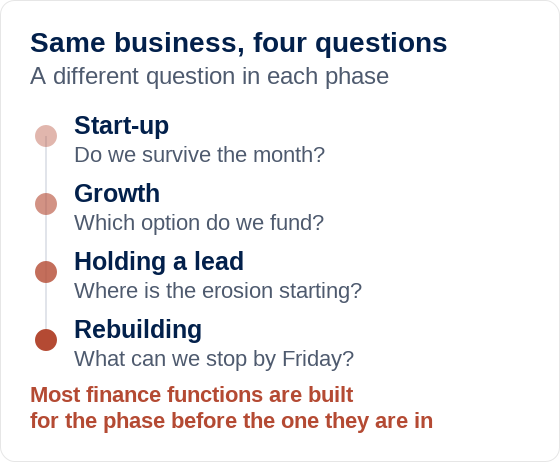
Nothing announces the move from one phase to the next. The business just starts asking a question the finance function was never built to answer, and everyone carries on being good at the old one.
I have never met a founder who got into trouble because they were bad at the phase they were in. I have met plenty who were still winning the one before it.
This is also why "we need a bigger finance team" is often the wrong first answer. More people doing start-up finance in a growth business gets you the start-up answers faster. What changes the outcome is pointing the finance function at the new question. I've set out what that looks like at different sizes in FP&A for small business owners at £1M, £5M and £20M.
Key takeaway: Ask what breaks first if you double, and when you'd have known. If the honest answer is "when it happened", your finance function is answering last phase's question.
Where to start this week
Ask the two questions. Don't argue with the answer, and don't fix anything yet. Just write down what breaks first and how much warning you'd get.
Then ask yourself which of the four phases your business is in now, and which one your finance function was built for.
If those two answers are different, you've found the gap. Which phase is your business in, and which one are your numbers still answering?