
Revenue is up 18%. Gross margin is down four points.
In most businesses the first number gets announced and the second one gets a footnote. The team hears growth, the board hears growth, and the four points go into the pack as a line of commentary that says margin was "impacted by mix".
Four points on £20M of revenue is £800K. That is not a footnote. That is a senior hire, a year of marketing, or the difference between funding next year's expansion from your own cash and borrowing to do it.
A business can sell more and keep less from every sale. Revenue growth is very good at hiding that, because it moves the number everyone watches in the direction everyone wants.
"Mix" is not an explanation
Here is the problem with the four points as most packs report them.
Total gross margin percentage tells you something changed. It does not tell you what to do, and it cannot, because it is an average of averages. The four points could be any of these, and the response to each is completely different:
- Prices have not moved while input costs have.
- Discounts that started as exceptions have become the list price in practice.
- Your fastest-growing product is your weakest-margin product.
- Your largest customer negotiated better terms at renewal.
- Fulfilment or delivery costs have risen.
- Sales commission rewards revenue, so the team is selling revenue.
- The customer mix has shifted toward a lower-margin segment.
Seven causes, one symptom. Reporting that stops at the symptom leaves everyone guessing, and the guess usually lands on whichever cause the loudest person in the business already believed in.
Four buckets
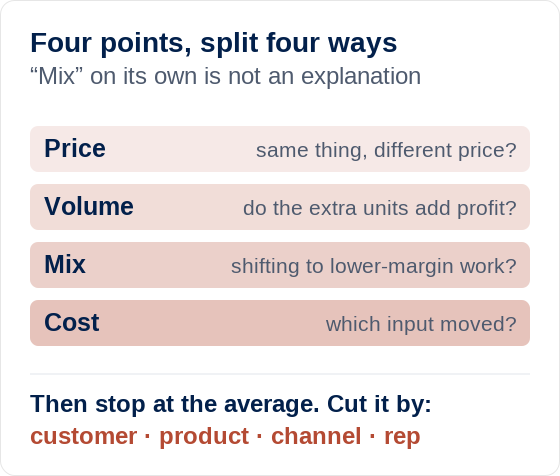
Break the margin movement into four parts. Each one is a different question with a different owner.
Price. Are we charging more or less for the same thing than we were a year ago? This is the cleanest to measure and the most uncomfortable to look at, because it is the one nobody has to approve. Prices drift down through a thousand small concessions.
Volume. Are the extra units actually adding profit? More volume at a positive contribution margin helps. More volume that pulls in extra warehousing, overtime and freight may not.
Mix. Are customers moving toward lower-margin products, channels or contracts? This is the one that most often explains a multi-point move, and the one most likely to be described as "mix" and then left there.
Cost. Which input moved, by how much, and can it be passed through? A supplier increase you absorbed in March is still being absorbed in November unless somebody decided otherwise.
Four numbers that add up to your four points. Now the conversation has somewhere to go.
"Revenue is growing" leads to congratulations. "Revenue is growing because low-margin business is becoming a larger share of the company" leads to a decision.
Then stop looking at the average
The business average is the least useful cut of margin you own. It is where every interesting fact goes to be cancelled out by its opposite.
Cut it four ways instead.
By customer. Rank every customer by gross margin percentage and by gross margin pounds. The two lists will not match, and the customers that appear high on one and low on the other are your most interesting conversations.
By product or service line. Margin by line, next to growth by line. A fast-growing line below your portfolio average is a mathematical certainty of future margin decline, and you can see it a year ahead.
By channel. Direct, reseller, marketplace and tender work rarely carry the same economics, and the costs that differ between them often sit below the gross margin line where nobody attributes them.
By salesperson. Not to performance-manage anyone. To find out what your commission scheme is actually buying. If one rep's deals run five points under everyone else's, that is a design question about incentives.
The leak is usually obvious within an hour of doing this, and it is usually in a place nobody had been arguing about.
The version of this I see most often
The pattern that comes up again and again in growing businesses looks like this.
One large account expands quickly. Everyone is delighted. That account happens to sit five margin points below the portfolio average, because it was won on price three years ago and has been repriced upward exactly never.
As that account grows as a share of revenue, the company's blended margin falls, even though not a single product has become less profitable and no supplier has raised a price. Every individual number is fine. The mix did it.
The decision that follows is not "fire the customer". It is a repricing conversation at the next renewal, with a number attached and a walk-away point agreed in advance. That is a very different meeting from the one that starts with "margin is down four points".
It is also worth checking the reverse: whether the growth was bought with discounting. On a 40% margin, a 10% discount needs a third more volume just to stand still, which is the arithmetic I set out in the discount article. Strong revenue growth and falling margin together is exactly the signature that sum predicts.
Key takeaway: Total margin percentage tells you something moved. Split the movement into price, volume, mix and cost, then cut it by customer, product, channel and salesperson. The leak is usually obvious once you stop looking at the average.
Where to start this week
Pull gross margin by customer for the last twelve months, ranked two ways: by percentage and by pounds.
Look at your five largest customers by revenue and find where they sit on the percentage list. If your biggest account is in the bottom half, you have found the four points, and you have found them in time to do something before the next renewal.
That is the job finance should be doing for you. Not confirming that a number moved and by how much, but explaining why it moved, whether you should care, and what to change next.
Which of your five biggest customers sits below your average margin?